
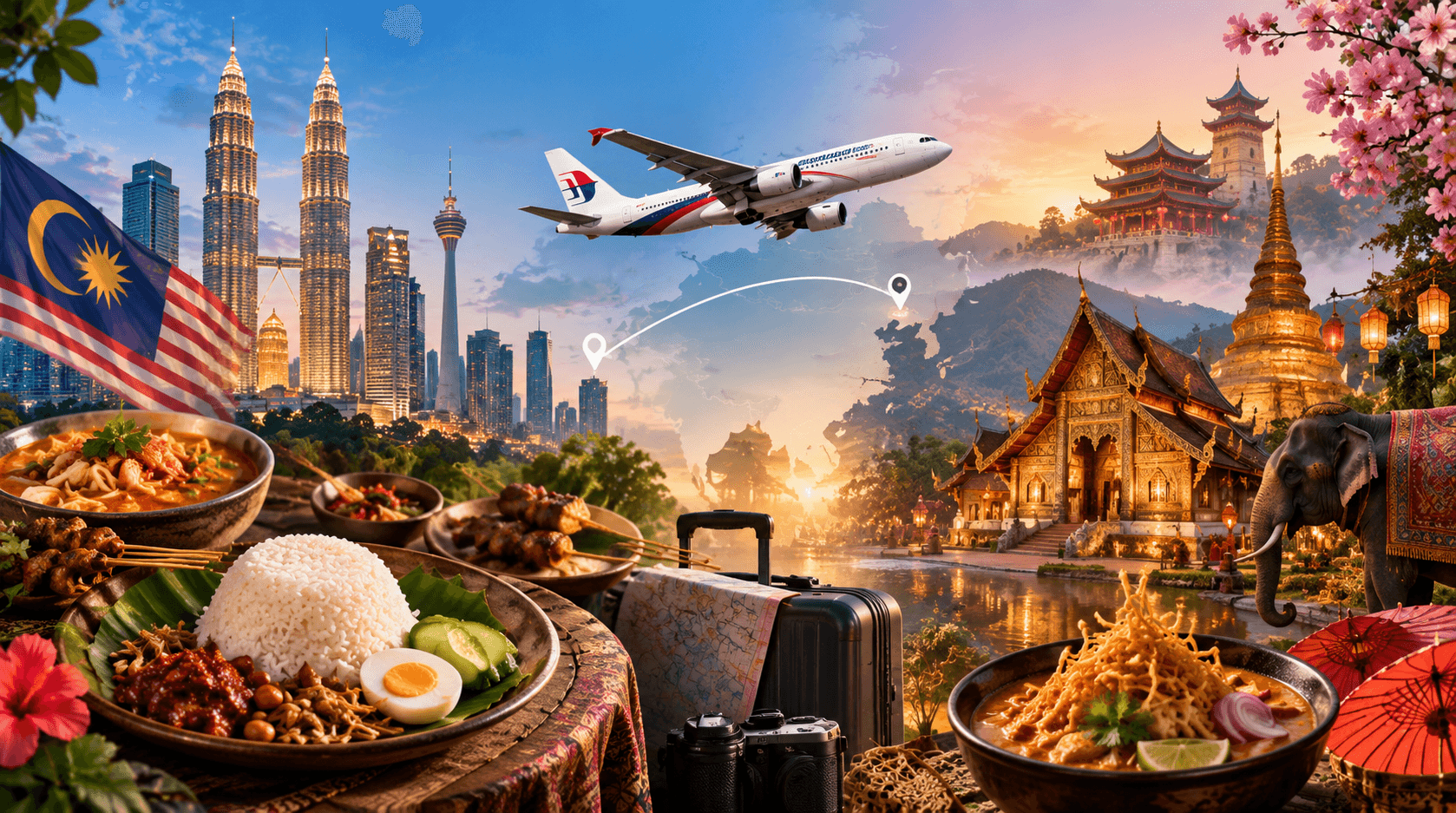
How Malaysia Airlines Turned a Route Launch Into a Culinary Story Worth Following
Most airlines launch a route with an announcement, a map and a promotional fare. Malaysia Airlines took a different runway. Its “Time for Chiang Mai” campaign used food as an entry point into culture, turning a single route launch into a 360-degree storytelling journey that spanned digital content, an on-ground dining experience, an influencer cooking class, an in-flight feature and the inaugural flight itself.
When the carrier introduced its Kuala Lumpur–Chiang Mai route in 2024, marking its 16th ASEAN destination, it entered a city already well served by established carriers and already familiar to Southeast Asian travellers as a temple town and a mountain retreat. The challenge was not simply to be seen, but to be remembered — for a reason no competitor was offering.
Winning a Destination Everyone Already Thinks They Know
The route reinforced Malaysia Airlines’ positioning as “Your Gateway to Asia and Beyond” and gave the carrier a chance to rebuild pride in its network expansion. But Chiang Mai sits in a highly competitive corridor, and the deeper issue was never awareness — it was relevance.
As a newcomer, the airline needed to build preference for an already widely-marketed destination without repeating the familiar imagery of temples and mountains travellers already associated with it. The goal was to make Chiang Mai distinctly ownable by Malaysia Airlines, told through a lens no other carrier had used: one rooted in storytelling and cultural depth rather than conventional route-launch messaging.
Letting Food Carry the Culture
Malaysia Airlines began with a simple question: what actually inspires travellers to choose a destination? Increasingly, the answer is experience — and food sits at the centre of it. Culinary tourism was already on a sharp global rise, growing from an estimated US$11.5 billion in 2023 to US$13.58 billion in 2024, and projected to reach US$40.53 billion by 2030, with travellers now spending around a quarter of their travel budget on food and beverages alone.
That insight became the campaign’s way in. Rather than leading with generic travel visuals, the airline chose to introduce Chiang Mai’s lesser-known culinary identity, using food as a route to the destination’s traditions, people and Lanna heritage. To lead the narrative with authenticity, it partnered with one-MICHELIN-starred chef Darren Chin — known for his restaurants Gai Express and Gai by Darren Chin, and for his modern interpretations of Northern Thai cuisine. Beyond his credentials, Chin’s mindset of continuous evolution mirrored values the airline wanted associated with its own brand.
Working alongside Malaysia Airlines has opened my mind and soul. This experience has given me the opportunity to see above and beyond my craft. The cross-culinary cultures have broadened my perspectives on sustainable living. — Darren Chin, One-MICHELIN-Starred Chef
From Documentary Series to the Departure Gate
At the centre of the campaign was An Epicurean Journey by Chef Darren Chin, a four-episode documentary-style series following Chin and a Malaysia Airlines cabin crew through Chiang Mai’s culinary landscape. Each episode moved between MICHELIN Bib Gourmand restaurants such as Magnolia Café and Rasik Local Kitchen, night markets, village kitchens and farms, revealing how Northern Thai cuisine is shaped by tradition and biodiversity. The series was amplified through skippable and non-skippable YouTube in-stream ads, supported by Instagram, Facebook, TikTok and LinkedIn content that built anticipation ahead of the inaugural flight in August.
The storytelling then moved off-screen. Malaysia Airlines hosted an immersive Northern Thai-inspired launch dinner at Gai by Darren Chin for media, Enrich loyalty members, KOLs and trade partners, where dishes discovered during the series — including khao soi gai, northern kingfish larb, wild coral trout in hor mok and Songkhla river prawn — were translated into a curated multi-course menu.
- A hands-on Northern Thai cooking class in Chiang Mai, in partnership with the Tourism Authority of Thailand, let regional influencers recreate dishes under Darren Chin and Chef Kritphan of Chiang Mai Marriott Hotel — generating organic content rooted in genuine discovery.
- The airline’s in-flight magazine, Going Places, carried a feature offering readers deeper insight into Chin’s journey and the cultural significance of Northern Thai cuisine.
- On the inaugural flight itself, passengers received a snack pack featuring luk chup and chilled citrus drinks from Thailand — a first taste of Northern Thai flavours before they had even landed.
A Campaign That Beat Its Own Targets
The food-led approach delivered results that exceeded the campaign’s original goals across nearly every metric. On awareness, it generated 13.21 million YouTube views regionally, well above typical route-launch benchmarks, alongside 370,000 clicks to the campaign landing page — more than double the original target of 150,000. The four long-form videos held a 62% average view-through rate, proving sensory-led storytelling could sustain attention even in longer formats. Two top-performing social posts reached up to 9.55 million impressions, 9.49 million reach and 9.49 million views, with engagement rates between 1.7% and 1.8%.
On consideration, searches for Chiang Mai rose by 25%, well past the campaign’s 15% target. Commercially, route revenue grew by 35% against the preceding four weeks, ahead of the 30% goal, while the inaugural flight launched at a 90% load factor, surpassing the 85% target. The campaign also coincided with a 209% increase in brand value, rising to US$607 million and placing Malaysia Airlines 45th globally.
Launching a new route in a competitive market requires more than announcing another destination. It requires giving travellers a compelling reason to choose us. By celebrating Chiang Mai’s rich culinary heritage and sharing it through multiple touchpoints, we created a campaign that differentiated Malaysia Airlines while staying true to our promise of Malaysian Hospitality. — Dersenish Aresandiran, Chief Commercial Officer, Airline Business, Malaysia Aviation Group
Why Marketers Should Pay Attention
The real lesson of “Time for Chiang Mai” is that a launch does not need to compete on price or frequency alone. By anchoring the work in food — something travellers already associate with meaning, memory and discovery — Malaysia Airlines positioned itself not as the newest carrier on the corridor but as a destination specialist that could bring travellers closer to a culture before they ever boarded. For any brand navigating a crowded market, the takeaway is that relevance, not just reach, is what turns a new offering into a lasting connection.
About the Campaign
“Time for Chiang Mai” was built as a connected, multi-channel journey rather than a set of standalone activations. A video series sparked interest, on-ground experiences translated the story into KOL-generated content, and the narrative carried through the in-flight magazine and onto the inaugural flight — ensuring travellers met the same story at every stage. Performance was measured against pre-set awareness, consideration and commercial targets, each of which the campaign surpassed.
Background: Malaysia Airlines
Operated under Malaysia Aviation Group, Malaysia Airlines positions itself as “Your Gateway to Asia and Beyond,” with a brand promise centred on Malaysian Hospitality. The Kuala Lumpur–Chiang Mai service, launched in 2024, marked the carrier’s 16th ASEAN destination and reflected a wider push to expand its regional network with differentiated, experience-led marketing.
Key Takeaways
- Food as the hook. Instead of temples and mountains, the campaign led with Chiang Mai’s culinary identity — tapping a culinary-tourism market projected to grow from US$13.58 billion in 2024 to US$40.53 billion by 2030.
- Awareness that overshot. The work drew 13.21 million YouTube views and 370,000 landing-page clicks — more than double the 150,000 target — with a 62% average view-through rate on long-form video.
- Intent moved too. Searches for Chiang Mai rose 25% against a 15% goal, signalling curiosity converting into travel intent.
- Commercial proof. Route revenue climbed 35% versus the prior four weeks (goal: 30%), and the inaugural flight departed at a 90% load factor against an 85% target.
- Brand lift. Malaysia Airlines recorded a 209% jump in brand value to US$607 million, ranking 45th globally.
- The transferable idea. A one-MICHELIN-starred chef, an in-flight feature, a cooking class and a snack pack turned a route launch into a single, repeatable story — proof that relevance beats reach.