
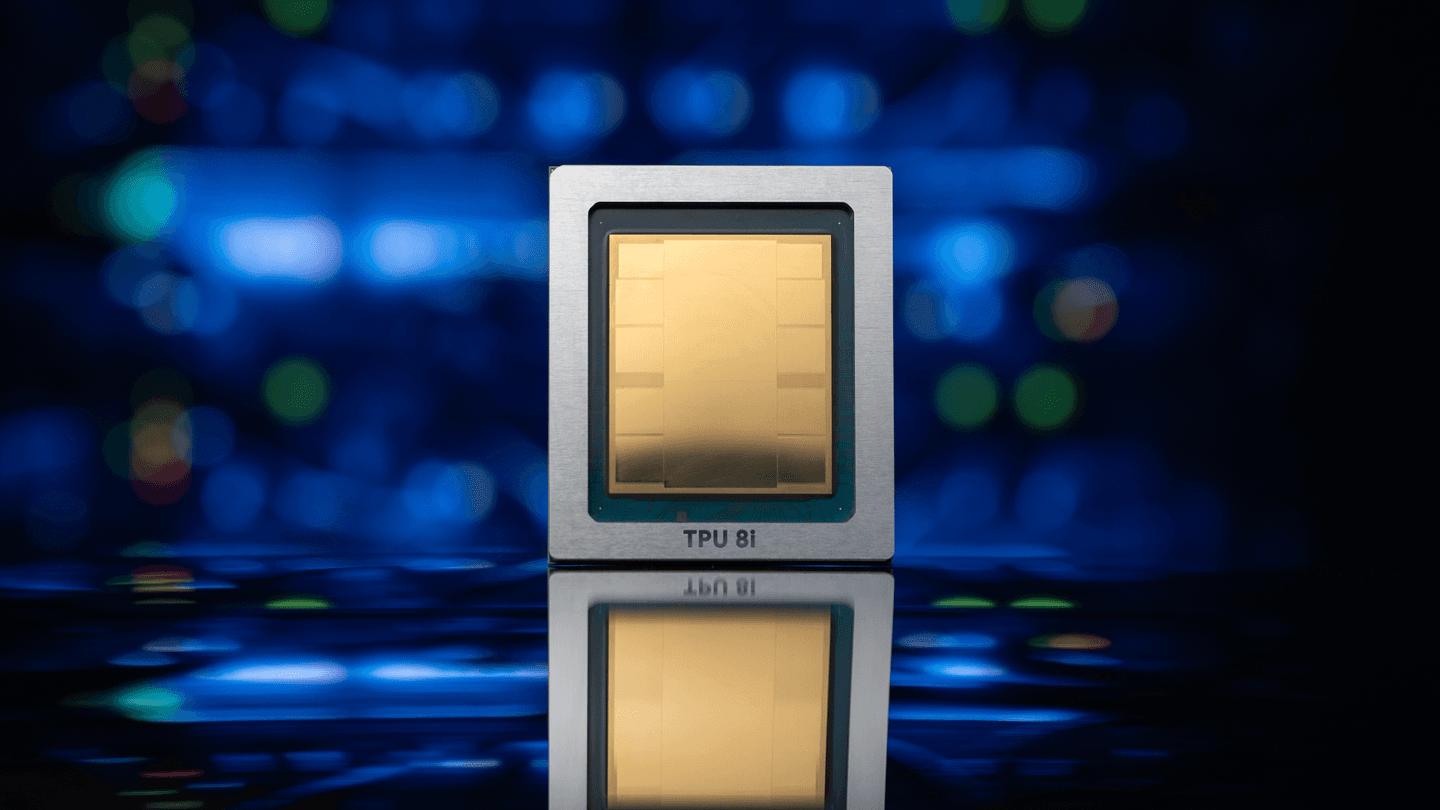
Google Introduces New TPUs to Support Enterprise AI Workloads
Google has introduced two new Tensor Processing Unit (TPU) systems designed to address the growing computing requirements of enterprise artificial intelligence applications. The new TPU 8tx and TPU 8i Max expand Google's eighth-generation TPU portfolio, with a focus on secure AI processing and memory-intensive workloads.
The announcement reflects Google's strategy of developing specialised AI infrastructure as organisations move from traditional computing workloads towards more advanced AI applications.
TPU 8tx Focuses on Secure Enterprise AI
The TPU 8tx is designed for government agencies and businesses operating in regulated industries where data security is a major requirement.
The system includes hardware-level confidential computing capabilities intended to protect sensitive information and model weights during processing.
Google says the TPU 8tx can support private model fine-tuning, model distillation and reinforcement learning for AI agents without requiring organisations to move sensitive data between separate computing clusters.
The system also combines Google's TPU technology with fifth-generation AMD EPYC processors and its Boardfly networking technology. Google reports that the configuration can deliver up to two times lower latency compared with the TPU 8t for relevant workloads.
TPU 8i Max Targets Memory-Intensive AI Applications
The second system, TPU 8i Max, is designed for applications that need to process large amounts of information simultaneously.
These include AI coding assistants working across extensive software codebases, systems analysing lengthy video content and applications coordinating multiple AI agents.
Google has combined two TPU 8i chips into a single package, doubling computing capacity, on-chip static random-access memory and high-bandwidth memory bandwidth compared with the standard TPU 8i.
The configuration provides 768 MB of on-chip SRAM and 17.2 TB per second of HBM bandwidth, according to reporting by TechTarget.
The design also fits within the existing rack footprint, allowing organisations to increase computing capacity without requiring additional rack space.
Google Expands Its Eighth-Generation TPU Portfolio
With the latest announcement, Google's eighth-generation portfolio includes four specialised systems:
TPU 8t: Designed for large-scale AI model training.
TPU 8i: Built for low-latency AI reasoning and inference.
TPU 8tx: Focused on secure and confidential AI computing.
TPU 8i Max: Designed for large context windows and memory-intensive applications.
Google says its modular approach allows it to adjust memory, networking, packaging and security configurations around existing chip designs. This enables the company to develop specialised computing systems more quickly as enterprise requirements evolve.
Google Strengthens Competition in the AI Chip Market
The expansion comes as Google looks to strengthen its position in the AI accelerator market, where Nvidia remains a major supplier of processors used for AI training and inference.
Google has gradually expanded access to its custom TPUs beyond its internal operations, making them available through Google Cloud and exploring deployments in customer data centres.
The company says its TPU business now serves nearly 100 customers, including AI research organisations, retailers, trading firms and universities.
Its partnership with Oracle is also expected to extend TPU access through Oracle Cloud Infrastructure, with deployments planned to begin in 2027.
What This Means for Enterprise AI
The introduction of TPU 8tx and TPU 8i Max highlights how AI infrastructure is evolving to address different enterprise requirements.
Businesses increasingly need computing systems that can process sensitive information securely, support large AI models and coordinate multiple intelligent agents.
By offering specialised configurations for these workloads, Google is positioning its TPU platform as an alternative for organisations looking to expand their AI infrastructure.
As enterprise AI adoption grows, competition among cloud providers and chip developers is likely to focus not only on processing performance but also on security, memory capacity, energy efficiency and overall operating costs.