
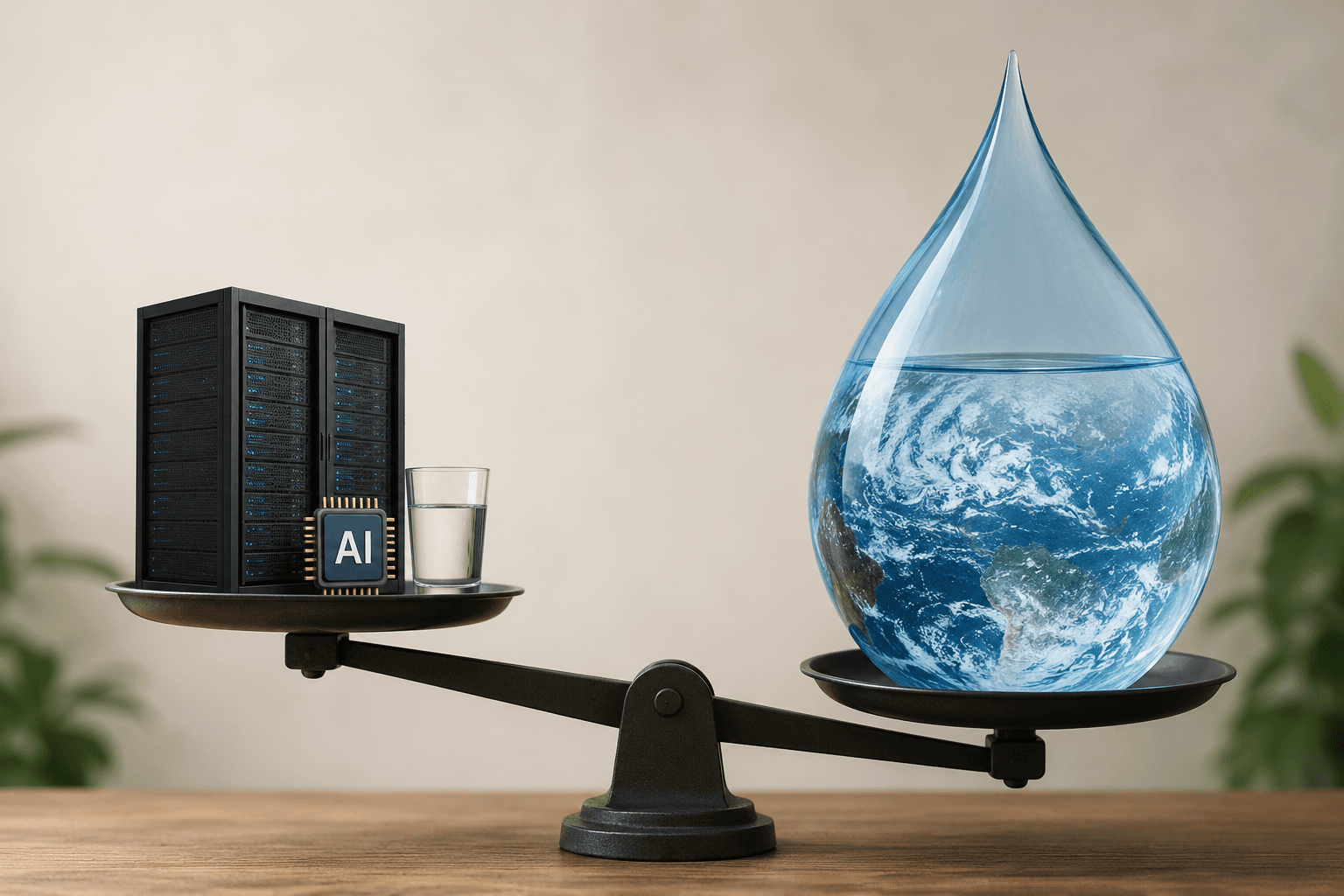
AI's Water Problem Is Smaller Than You Think — the Real Crisis Is Bigger, and Finally Solvable
A new applicant has joined a very old fight over water. Across Arizona, Georgia, Virginia and central Texas, hyperscale AI data centers are showing up on the utility docket asking a deceptively simple question: how many million gallons a day can you commit to us, and can you commit them on the hottest day of the year? The panic that followed is mostly misdirected — AI's water draw is modest, and the same industry now queuing at the counter is building the tools to fix a water crisis far larger than itself.
From the highway these buildings look like beige logistics warehouses. Inside, they are among the most thermodynamically violent structures ever built: racks of GPUs so densely packed that the heat would cook the hardware in minutes if it weren't hauled away continuously. Hauling it away is what the water is for. The debate is genuinely messy and both sides have a point — critics see a private industry quietly commandeering a public resource during a drought, while the industry responds, correctly, that its total draw is small next to agriculture's, that per-query numbers are wildly overstated, and that new cooling designs are pushing on-site water toward zero. What makes the fight matter isn't the national average. It's the local peak, the specific aquifer, the specific August afternoon.
And it arrives at the worst possible moment. The planet is losing an estimated 324 billion cubic meters of freshwater every year to unsustainable land use, wetland loss and slow continental drying. Roughly 2.1 to 2.2 billion people — one in four humans — live without safely managed drinking water at home. About 106 million drink untreated surface water straight from rivers and ponds. In sub-Saharan Africa, nearly 400 million people lack even basic access, and water-related disease still kills around 1,000 children under five every single day.
What the Cloud Actually Drinks
For years the environmental conversation about computing was about carbon, with water buried in sustainability reports under "operational metrics." That was a mistake, because the physics were never subtle. Heat from the chips is carried out of the server hall by a closed coolant loop, which dumps it into a second, open loop — the cooling tower — where water is sprayed into moving air and deliberately evaporated. It's the same trick your body uses when it sweats, and it is consumptive by definition: that water goes into the sky, not back to the river. Depending on climate and tuning, it costs between 1 and 9 liters of water per kilowatt-hour of server energy.
Multiply that by the buildout. In 2023, U.S. data centers consumed — permanently evaporated — roughly 17.4 billion gallons of water on site, or 66 billion liters, per Lawrence Berkeley National Laboratory. By 2028, LBNL projects hyperscale facilities alone will consume between 16 and 33 billion gallons a year (60 to 124 billion liters).
- Separately, U.S. data centers are projected to require 697 to 1,451 million gallons per day of new water capacity between 2024 and 2030 — comparable to New York City's average daily supply of about 1,000 MGD. That is peak infrastructure sizing, not annual throughput, and the bill to build it runs an estimated $10 billion to $58 billion.
- Globally, AI demand is on track to account for 4.2 to 6.6 billion cubic meters of water withdrawal by 2027 — that is 1.1 to 1.7 trillion gallons, or roughly the annual water withdrawal of Denmark four to six times over.
The Myth, and the Part That Is Real
Those figures look like they contradict each other. Take 1,451 MGD, multiply by 365, and you get 530 billion gallons a year — thirty times the 17.4 billion gallon figure. Nothing is broken; they measure three different things. Withdrawal is water taken out. Consumption is the share that never comes back. Capacity is how big the pipes must be to serve the worst day of the year — a size, not a flow, which is why multiplying it by 365 is like multiplying a stadium's seat count by 365 to estimate attendance.
With the units straight, the myth-busting goes quickly:
- The per-prompt number is overstated. Early modeling put a 100-word AI output at 519 milliliters — the "a single chat drinks a bottle of water" claim. Newer hardware and better-instrumented facilities put direct on-site consumption closer to 5 to 15 milliliters per prompt. A mouthful, not a bottle.
- The national totals are modest. By 2030, U.S. data centers are projected to account for just 0.6 to 1.1 percent of public water withdrawals. Against agriculture — 70 percent of global freshwater use — the entire digital economy is a rounding error.
- The cross-sector comparisons are mostly broken. The "one hamburger costs hundreds of gallons" retort leans on lifecycle footprints dominated by green water — rain that fell on pasture anyway. Less than 2 percent of a burger's footprint comes from a public water system, while a data center's cooling water is metered, treated, potable municipal supply.
Here is the part that survives all of it. Data centers consume what everyone else merely borrows. Urban homes consume just 5 to 15 percent of what they take — about 12 percent averaged across all American public water users — because the rest goes down the drain and back to the river. An evaporative cooling tower consumes 70 to 90 percent, because turning water into vapor is the cooling mechanism. There is no drain. Which is why an industry that is 0.6–1.1 percent of public water withdrawals in 2030 is 4 to 7 percent of public water consumption — per gallon delivered, a data center removes water from the watershed roughly six times faster than the city around it.
And it does so on the worst possible day. Utilities size for peak, not average, and peak daily demand can hit six to ten times the annual average — precisely when evaporative cooling load goes vertical. Some planned facilities have requested up to 8 million gallons per day of peak capacity, enough to exhaust a suburban county's entire surplus and the safety margin it keeps for fires and main breaks. That is the real fight — not the chatbot, but the peak, landing on one specific aquifer in one specific town.
The Engineering Answer, and Its Asterisk
The technical response has been fast and real. Cooling designs now span a clear spectrum:
- Air plus evaporative towers (10–30 kW racks): very high water use, 1 to 9 L/kWh evaporated; cheap to build but brutally exposed to drought.
- Direct-to-chip (DTC) liquid (30–100 kW racks): minimal direct loss, closed loops, moderate cost, and — crucially — retrofittable into existing halls. It bolts a cold plate onto the processor and cuts cooling energy by up to 30 percent.
- Single-phase immersion (50–150 kW racks): near-zero on-site evaporation, but expensive — realistically a new-build decision.
- Two-phase immersion (over 100 kW racks): zero water loss via dielectric boiling; the priciest and highest-performance option for extreme AI workloads.
Immersion cooling drowns the entire server board in non-conductive dielectric fluid, eliminating the evaporative tower outright, and the newest AI-factory reference architectures claim near-zero on-site water by circulating coolant hot enough that plain dry coolers can shed the heat into ambient air. But "zero-water computing" is a claim about the building, not the system. Thermoelectric power plants are themselves gigantic evaporative machines: in 2023, U.S. data centers consumed roughly 211 billion gallons of indirect water — twelve times their direct footprint — at the plants generating their electricity. Moving evaporation 200 miles away helps the local watershed; it does not make the water disappear.
The most elegant fix is scheduling. Much AI compute — training, batch inference, index rebuilds — is delay-tolerant and doesn't care whether it runs at 2 p.m. in Phoenix or 4 a.m. in Quebec. Schedulers that treat watershed stress as a first-class variable alongside price and carbon can push thirsty work toward wet places and cool hours. Under the optimistic scenario — cutting water intensity by 10 percent a year — the capacity requirement falls from 697–1,451 MGD to 227 to 604 MGD. Less than half. On current evidence, AI's water problem is solvable with money and engineering that already exist.
The Elephant Nobody Photographs
The water system those data centers plug into is a different matter. Agriculture accounts for roughly 70 to 72 percent of all freshwater withdrawals on Earth. In California's Central Valley, nut orchards occupy less than 1 percent of U.S. cropland yet consume roughly 538 billion gallons a year; irrigated corn takes 1.86 trillion gallons; and U.S. beef production runs an estimated 2.5 trillion gallons on a full lifecycle basis. Water moves in strange directions because of virtual water — the invisible water embedded in a traded good. Since 2010, virtual water trade has saved an estimated 475 billion cubic meters globally by letting arid countries import calories, yet it also runs backward when water-stressed regions keep exporting thirsty commodities because farmers respond to commodity prices, not aquifer levels.
Precision Irrigation, and the Finance Trap Behind It
Flood irrigation loses staggering volumes to evaporation and deep percolation. Drip and micro-sprinkler systems — commercialized by Israeli firms like Netafim — deliver metered water directly to the roots, where plants absorb about 95 percent of what is applied. Universal adoption could save 50 to 70 percent of agricultural water by 2050. Yet drip reaches only about 5 percent of farmland worldwide. Installing it costs roughly $1,000 to $3,000 per acre against water savings of 30 to 50 percent, similar fertilizer savings, and yield gains of 10 to 30 percent, with typical payback in two to five years on a system lasting ten to twenty. An excellent investment on paper — and still barely deployed.
Israel is the standing demonstration of the alternative. Drip now waters roughly 75 percent of Israeli crops, and the national results come from OECD and World Bank accounting rather than any marketing department:
Between 1990 and 2016, Israeli agricultural output grew by nearly 70 percent while total agricultural water use stayed essentially flat. Between 2000 and 2018, agriculture's share of national freshwater abstraction halved, from 64 percent to 35 percent. And the share of "marginal" water — treated wastewater and saline sources — rose from 14 percent in the early 1990s to nearly two-thirds by 2020. — OECD and World Bank water accounting
But the technology did not deploy itself on ROI alone. Israel priced water, metered it nationally, allocated it by quota, and built conveyance and treatment infrastructure with public capital. Almost everywhere else, water is effectively free at the margin — so the largest line in drip's return is worth nothing to the farmer, and a smallholder cannot raise $2,000 an acre at any available interest rate. The binding constraint on agricultural water technology is finance and pricing, not engineering.
Seeing, Draining and Banking the Water
You cannot manage what you cannot see. Platforms like OpenET now use NASA and USGS satellite imagery to calculate evapotranspiration field by field, for free, turning groundwater from an invisible commons into an accountable ledger held by farmers rather than a distant regulator. Three more interventions punch far above their cost:
- The rice fix. Rice absorbs an estimated 34 to 43 percent of all global irrigation water, mostly because paddies are kept flooded to suppress weeds. Alternate Wetting and Drying (AWD) — a perforated tube pushed into the mud and a change of habit — cuts irrigation water 15 to 30 percent with no yield loss and slashes paddy methane 30 to 70 percent. Its benefit-to-cost ratio is almost implausible.
- Banking water underground. Managed Aquifer Recharge, and California's Flood-MAR variant, spreads high winter flows across farmland to percolate into depleted aquifers. Median cost runs about $410 per acre-foot against roughly $2,100 for new surface storage — five times cheaper for the same water.
- The rest of the toolkit. Subsurface drip, deficit irrigation, laser land levelling (cutting irrigation water 20 to 30 percent), drought-tolerant cultivars and controlled-environment agriculture (up to 90 percent less water for high-value produce) are all moving fast.
The Water That Never Arrives
Before a drop reaches a farm or a server rack, an appalling amount vanishes into the ground. The industry term is non-revenue water: treated, pressurized drinking water lost through a buried crack. In the United States there is a water main break roughly every two minutes, and the country loses between 1.7 and 2.2 trillion gallons of treated drinking water every year — on the order of 12 to 15 percent of everything public systems produce. Even at their projected 2030 withdrawals of 80 to 150 billion gallons a year, data centers would draw between a tenth and a twenty-seventh of what utilities lose through cracked pipes. The most water-intensive thing in American water infrastructure is American water infrastructure.
The fix uses the same AI that started the story. Companies like FIDO Tech deploy IoT acoustic sensors and models trained to isolate a leak's hiss from urban noise, estimating its size and position so crews dig once, in the right place. Asterra uses Synthetic Aperture Radar on low-Earth-orbit satellites — instrumentation originally built to hunt subsurface water on Mars — to scan entire cities from space, distinguishing treated drinking water pooling underground from ordinary groundwater. And then there is Tokyo, which after World War II leaked 80 percent of what it carried.
Tokyo replaced aging cast iron mains with ductile iron, swapped service pipes for earthquake-resistant stainless steel, divided its 27,000-kilometer network into thousands of measurement blocks to run Minimum Night Flow analysis, sent crews out with subsurface radar, and injected inert helium into suspect mains to sniff for escapes at street level. Today its leakage rate is 3.0 to 3.2 percent. From 80 to 3 — saving nearly $480 million a year and cutting 54,000 tonnes of CO₂ annually, using nothing exotic beyond fifty years of patient engineering.
The Circular City
The 20th-century urban model is a straight line: take water from a distant river, purify it at great expense, use it once, send it to the ocean. The alternative is a loop, and America's two best demonstrations could not differ more in scale.
- Las Vegas. The Southern Nevada Water Authority captures and recycles 99 percent of all water used indoors, returning it to the Colorado River via the Las Vegas Wash and earning return-flow credits — making indoor use effectively a closed loop. The counterintuitive lesson: the Bellagio fountains aren't the problem; lawns are, because sprayed water evaporates and is gone forever.
- San Francisco. A 2015 ordinance required new buildings over 100,000 square feet to install on-site recycling. Inside the 61-story Salesforce Tower, Epic Cleantec runs the largest on-site commercial blackwater recycling system in the U.S., returning up to 30,000 gallons a day, recycling up to 95 percent of the building's wastewater, offsetting 7.8 million gallons of potable demand a year, and paying for itself in three to seven years. To beat the yuck factor, Epic even brewed a beer, Epic OneWater Brew, from purified graywater.
California, meanwhile, legalized the world's most rigorous Direct Potable Reuse rules — adopted December 2023, effective October 2024 — letting treated wastewater go directly into a public drinking system with no aquifer "buffer." The mandated treatment train runs ozone with biologically activated carbon, reverse osmosis (average rejection above 99 percent), and UV advanced oxidation. Pathogen requirements are the strictest in the industry: 20-log reduction for enteric viruses (a hundred-quintillion-fold cut), plus 14-log for Giardia and 15-log for Cryptosporidium. The plants themselves are shrinking too: the Nereda process, built on Aerobic Granular Sludge, delivers up to 75 percent less footprint and up to 50 percent less energy by growing purifying bacteria as dense, fast-settling granules.
Harvesting the Sky, Mining the Sea
When rivers are allocated and aquifers drawn down, two effectively unlimited reservoirs remain: the atmosphere and the ocean. Omar Yaghi at UC Berkeley, inventor of metal-organic frameworks (MOFs), cracked the first. MOFs are crystalline molecular sponges so porous that a single gram can unfold to the area of a small field, and they can be tuned to grab water vapor down to 10 percent relative humidity. A harvester built around an aluminum framework called MOF-303, with no moving parts and no power, produced 210 to 285 grams of water per kilogram of MOF per day in Death Valley; add a small solar fan and an electrified version yields over 5 liters daily from just 200 grams of material.
On the ocean side, Israel built five Mediterranean desalination plants and became a water exporter — desalination now supplies 60 to 80 percent of Israeli drinking water, and the country reuses roughly 90 percent of its municipal wastewater (against about 20 percent for Spain and 1 to 10 for the U.S.). The breakthrough was mechanical: Energy Recovery Devices capture the near-full pressure of rejected brine and transfer it into the incoming feed, cutting plant power up to 60 percent. Materials keep improving — Aquaporin membranes embed biological water channels that pass water at up to a billion molecules per second and claim up to 70 percent less energy; MXene nanochannels offer exceptional ion selectivity; and solar hydrogels reach evaporation rates above 3.0 to 3.6 kg per square meter per hour under one sun.
Even the waste is being reframed. Hypersaline brine is a pre-dissolved ore body: brine mining splits it into acid and base streams to precipitate magnesium, calcium, potassium and — the prize — lithium, potentially turning a desalination plant into a dual-revenue, possibly carbon-negative minerals operation. And for "forever chemicals" that resist all filtration, Supercritical Water Oxidation takes wastewater past water's critical point — above 374 °C and 221 bar — where carbon-fluorine bonds simply shatter and PFAS is mineralized out of existence.
The Gap Between the Lab and the Tap
Every technology above exists, and several are deployed at commercial scale today — yet none of it matters if the pipe carrying the result is 90 years old and made of lead. The American Society of Civil Engineers' 2025 Report Card gave U.S. infrastructure an overall grade of C, its highest ever, but drinking water earned a C−, wastewater a D+ and stormwater a D. Across all categories the ten-year funding gap runs roughly $3.6 to $3.7 trillion just to maintain the system. Water's own share of the hole is $91 billion in 2024 alone, growing to a cumulative shortfall of more than $2 trillion by 2043, with drinking water systems alone needing over $625 billion across the next twenty years.
The upside is startling. A 2020 analysis found that fully funding water infrastructure would generate a $4.5 trillion gain in GDP (cumulative across 2020–2039), create nearly 800,000 new jobs by 2039, and raise annual household disposable income by more than $2,000 — conditional on spending roughly $109 billion a year above current levels, against a baseline in which the U.S. was meeting just 37 percent of its capital water needs. Six of those twenty years have already gone by.
Why Marketers Should Pay Attention
For anyone whose business depends on cloud and AI infrastructure, the headline risk isn't a chatbot quietly draining a reservoir — it's the collision between hyperscale peak-day water capacity and a public system already losing 1.7 to 2.2 trillion gallons a year to leaks. The most useful thing the technology industry could do for the world's water isn't merely drier cooling loops; it's that hyperscalers arriving in a town with capital, urgency and a direct interest in reliable water are the first entity in decades with both the money and the motive to rebuild the system. Whether new demand pays for the upgrade or just consumes the remaining slack is a policy choice being made right now, one municipal utility agreement at a time — and it will shape data-center siting, cloud pricing and the sustainability claims every AI-dependent brand makes for the next decade.
About the Research
Nearly every viral water statistic is either clarified or destroyed by three distinctions. Withdrawal is water taken out of a river, aquifer or main — the number utilities meter and plan around, and the most reliable class of water figure. Consumption is the share that never returns; it is almost never metered, but inferred from withdrawal minus return flow. Capacity is how big the pipes must be to serve the worst day — a size, never to be multiplied by 365. The much-quoted 697–1,451 MGD figure comes from a 2026 UC Riverside and Caltech study titled "Small Bottle, Big Pipe," which puts data centers' actual 2030 flows at 80 to 150 billion gallons of withdrawal and 60 to 110 billion gallons of consumption a year — about a third of the peak capacity that must be built to serve it. A further caution: a 2025 review found that most citation chains for the ubiquitous 70-percent agriculture figure dead-end in sources that never contained the number. The direction is not in doubt; the decimal places are.
Background: The Companies and Labs
The players named here span research, hardware and utilities. Lawrence Berkeley National Laboratory produced the definitive U.S. data-center water figures. Netafim pioneered commercial drip irrigation; OpenET turns NASA and USGS imagery into free field-level water accounting. FIDO Tech and Asterra hunt pipe leaks with acoustic sensors and Mars-derived satellite radar. The Southern Nevada Water Authority runs Las Vegas's 99-percent indoor recycling loop; Epic Cleantec builds on-site blackwater recycling into individual towers. The Nereda process, developed at Delft University of Technology, shrinks treatment plants with granular bacteria. Omar Yaghi's UC Berkeley lab invented the metal-organic frameworks behind atmospheric water harvesting, while Energy Recovery, Aquaporin and MXene research keep pushing desalination toward its thermodynamic floor.
Key Takeaways
- AI's direct water draw is small. U.S. data centers consumed 17.4 billion gallons in 2023 and will sit at just 0.6–1.1 percent of public water withdrawals by 2030 — a rounding error next to agriculture's 70 percent.
- The peak, not the average, is the real fight. Cooling towers consume 70–90 percent of what they take (versus ~12 percent for homes), and some sites request up to 8 million gallons per day of peak capacity on the hottest afternoon.
- Leaks dwarf everything. The U.S. loses 1.7–2.2 trillion gallons of treated water a year to cracked pipes — Tokyo cut its own losses from 80 percent to 3 percent, saving nearly $480 million annually.
- Agriculture is where the leverage is. Drip irrigation could save 50–70 percent of farm water, rice AWD cuts irrigation 15–30 percent for the cost of a pipe, and aquifer recharge runs $410 per acre-foot versus $2,100 for new dams.
- New water is being made from air and sea. MOF harvesters yield over 5 liters a day from 200 grams of material with sunlight; energy-recovery desalination cut plant power up to 60 percent, supplying 60–80 percent of Israel's drinking water.
- The bottleneck is money, not science. Closing the U.S. water funding gap — $91 billion short in 2024 alone — could add $4.5 trillion in GDP and nearly 800,000 jobs, but requires $109 billion a year above current spending.